Posts

Showing posts with the label Chemistry

How To - Masses & Solutions 2 - Chemistry

Image
I always had major problems when it came down to calculating the components for solutions and buffers. I don't know why, it should be as easy as A B C but I just couldn't do it. Now I have found the solution, a formula Or rather two :) I hope this can help you out - this should take about 5min to read and understand! 1. Method You need:  Startconc . (initial concentration),  Targetconc . (concentration of your target solution),  Targetvol . (volume of target solution) X here is the amount of the stock solution which we need, in millilitres. Of course you can reconstruct the formula to suit your needs, in the case that you are looking for another attribute than X 2. Method You need:  Startconc .,  Startvol . (volume in which the concentration of the stock solution is kept),  Targetconc .,  Targetvol . X is again, the amount which you need, in milllilitres, while A and B are just variables :)

Metabolism - Biochemistry

Hey guys - although we entered into Biochemistry with the post about Glycolysis   I have a little summary here, what metabolism in general is going to be for me, during this semester. "Metabolism is the summed up lot of chemical reactions in our bodily cells, which we living organisms need to extract energy (in form of food and minerals) to perform actions, grow, heal or improve our physical self." Because energy seldom comes in the form our cells can use it right away, we need processes to breakdown bigger chunks - catabolic processes - i.e. Glycolysis (greek for sugar-splitting), I mean this example is awesome, because stuff is literally being broken down. And also energy is won from this reaction. On the other hand side, we are not just a machine that consumes and spits out product 1:1 Our body has the possibility to store energy for later on (yeah, shake that fat belly - don't worry it's potential energy is over 9000). ANYWAY. So called anabolic processes relea...

How To -Glycolysis - Biochemistry

Image
We are starting into a new semester and that means I am getting into Biochemistry II with you guys. Main Topic this semester will be the metabolism and from experience I can say, the most difficult part is to remember all the different steps in the many metabolic cycles our body needs to stay functioning. Glycolysis happens generally in 10 steps and is the process of breaking down glucose into smaller sugars The reaction itself takes place in the cytosol and after investing 2 ATP you get 4 ATP and 2 NADH First Step: Phosphorylation of Glucose Enzymes: Hexokinase aka Glucokinase Components: Glucose , ATP Hexokinase catalyses under exclusion of water the two components glucose + ATP , the product is now negatively charged and therefor caught in the cytosol Second Step: Isomerization Enzymes: Glucosephosphate-Isomerase Components: Glucose-6-Phosphate This reaction is essential for step four, because only from fructose you can derive two C3-molecules. Without isomerization, we would ...

How To - Masses & Solutions 1 - Chemistry

Image
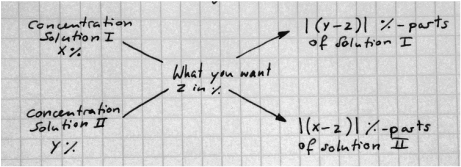
Hey there, I have had a lot of trouble with this one - probably also because I didn't practice so much... Making solutions and solvents of solutions is difficult, to me. So today we are gonna fix that ._. To calculate solutions with a concentration, there is a very simple formula the so called Andreas-Cross , this is what it looks like: We have two overlapping arrows with the target solution (Sol Z) and it's concentration we want to produce in the middle. The left side shows our base material (Solution I (Sol X), Solution II (Sol Y) and their respective concentrations) and on the right we will get how many parts of each solution we need to create Sol Z , by subtracting the percentage from Sol Z from Sol X / Sol Y and taking the modulus from that. *BUTT* Take a good look at the picture - Sol Y tells you how many parts of Sol X you need and the other way too!! 1. Example Sol X = 35% Acid; Sol Y = 15% Acid We want a 22% Solution mixed from Sol X and Sol Y Ta...