Posts

Showing posts with the label How To

How To - Determinants of Matrices
Image
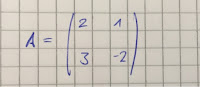
The determinant of a matrix is very useful and commonly asked for in exams. With it, you can determine if a matrix is invertible (thus find the inverse for sure, without wasting tons of precious time in an exam) and it's a sure way to get points even if you are pretty hopeless and just want to pass There are three basic cases for matrices, dimensions 2x2 , 3x3 and dimensions 3< . Results for the three exercises will be posted at the end. Tipp : a matrix can only be inverted if the determinant does not equal 0 ! In the case of matrix A (2x2) the main- minus minor-diagonal formula applies; with upper left times lower right, minus upper right times lower left. For example B (3x3) it becomes more complicated. We can apply the rule of Sarrus ( Wikipedia ). For that, we replicate the first two columns to the right side. Now we create the main and minor diagonals, as seen in the picture below: After this, we subtract the sum of the minors from the sum of the...

How To - Citric Acid Cycle

Image
The citric acid cycle is one of the central logistical hub in our metabolism. It provides oxidative breakdown for organic substances, energy by releasing CO2 and H2O from Acetyl-CoA and so on. There are 10 basic steps to the cycle and its goal is to catalyze the condensation of Oxalacetate to Citrate. I will list the  intermediates of this reaction and their respective enzymes , as well as their components : Citrate  + Aconitase -> cis-Aconitate   ( H20) cis-Aconitate + Aconitase ->  Isocitrate    ( H20) Isocitrate  + Isocitrate-dehydrogenase -> Oxalsuccinate    (NAD+, NADH) Oxalsuccinate  + Isocitrate-dehydrogenase -> Alpha-ketoglutaric-acid   (CO2) Alph a-ketoglutaric-acid  + alpha-ketoglutarate-dehydrogenase-complex -> Succinyl-CoA   (CoA, NAD+, CO2, NADH/H+) Succinyl-CoA  + Succinyl-CoA-Synthase -> Succinate  (GDP, ADP, GTP, ATP) Succinate...

How to - Java Interfaces and Abstrac Classes

Today's topic - what is an interface? And what the hell does that have to do with abstract classes? As you can see, we introduce this program not as a class, but an interface. Inside the interface there are methods, which can or can not contain any kind of parameters but the bodies of these methods are empty.  But why would you want that .__. Look at the interface as a kind of blueprint. When you are a contractor and you are supposed to build a whole neighbourhood with 14 houses that look the same (kitchen, 2 bedrooms, 3 baths and a porch) you might not want to sit down at your desk 14 times and draw plans for every single house if they are going to look the same fucking way in the end ._. Sure, you might want to paint one green and the other red - but that can be added later on. So our interface is a blueprint for a type of class that should in the future be used over and over again, with the same kinds of methods in them. Note here: once you implement an interface int ...

How To - Java Methods

Let's begin with the basics.  In the first post we took a look at the small Program HelloWorld which printed the message Hello World out into our command line. This was a very simple program and with a basic command, but when we write scripts or programs that calculate values, or help sorting stuff we will need methods. We will write a program that calculates the middle value of two fixed values we give the method. Try to read the code and understand what part stands for what: - class name, main method, what is being called in the main method So here again in line 1 we have a public class with the class name MiddleVal for Middle Value, then open brackets to open the class body, line 2 contains the main method (which makes this class autonomous in itself) which also calls out method in the 3. line with 2 parameters that we give to the method. Now we can take a closer look into line 6 - what does the method in line 3 actually do? It's called public static int mid...

How To - Complex Numbers

Image
We have reached the part about my studies which I don't enjoy so much. Math.  There is of course lots more to it than the few tutorials I can upload - especially since right now I am really busy studying for the exams to come, but here you go! A How-To about calculating with Complex Numbers (takes up to 10min to understand) The first part here focuses on complex numbers in their algebraic form, I will edit this tutorial however, to show you the polar-coordinate form, as soon as I have time :p When starting out with this topic, you will soon encounter the variable i . Because  i  is defined as  i^2 = -1  we can extend our Real Numbers so that the formula  becomes solvable:  x^2 +1 = 0 In the algebraic form complex numbers are written as z = x + iy If you want to work with complex numbers, these 4 rules will help you solve the test question at the end :) 1. Addition 2. Subtraction 3. Multiplication 4. Division ...

How To - Java Hello World

Hey guys, new year, new motivation, new yay. This is the start of my How To Java - so let's go :D When you start with any programming language and the additional self-t(orturing)eaching lecture, they will introduce you with this exercise public class HelloWorld{      public static void main(String[ ] args){           System.out.println("Hello World");      } } This non-humanity-threatening message is all cute 'n' shit but what exactly does it mean? This is already a fully functional program, so you deserve to be proud of yourself, but let's break this down: The first line in your code is usually gonna be your class name. Names are important, it is how you will later on find your program (or class) after you stored it away in your workspace somewhere, to incorporate it into a more complex program.  So class name here is HelloWorld . The curly bracket after your class name opens up to the body of your program -...

How To - Glyconeogenesis

Image
Since in 2015 the Biochem exam is around the corner in January, we are getting back with the metabolism pathways in our body. Maybe this is also a good way of keeping the fat level over the holidays in check :p But this post is not about fats - it's Gluyconeogenesis!! After investing 4 ATP and 2 GTP you will get glucose, this process takes part inside the Mitochondrium and the Cytoplasm The metabolic pathway which results in the generation of glucose  from non-carbohydrate substrates . These substrates which are pyruvate , lactate , glycerol and glucogenic AAs . This pathway is one of the core ones, which monitor our blood glucose levels, to avoid hypoglycemia. What you have to keep in mind is, that you can't just reverse glycolysis - there were some irreversible steps made in that pathway!!! First Step: Carbolization and de-Carbolization Enzymes: Pyruvat Carboxylase , PEP Carboxy kinase Components: Pyruvat , Oxalacetat , Phosphoenol-pyruvat (PEP) ...

How To - Variance & Standard Deviation

Image
Hey Guys, today we do a quick intro on some basic terms and formulas that are used frequently in statistics - Mode or Modal Value, Middle Value, Median, Variance and the Standard Deviation We have a class of 8 Girls and 8 Boys , so a total of 16 kids . To get the Modal Value (m) and therefore represent the level of the whole class, we count how often each grade showed up - in our case 2 and 3 Next comes what probably everyone did at least once in school; calculate the class average or our Middle Value (a small X with a line over its top; sorry I can't write it out here .__. ) Using the Median is actually just being nit-picky, but good to know. In case your teacher breaks into your house in the middle of the night and wants to know... you will probably never use this one in your life For uneven : look for the middle number For even : look for the two middle numbers, sum them up and divide by 2 - that's your median The formula for Variance may look difficult at first,...

How To -Glycolysis - Biochemistry

Image
We are starting into a new semester and that means I am getting into Biochemistry II with you guys. Main Topic this semester will be the metabolism and from experience I can say, the most difficult part is to remember all the different steps in the many metabolic cycles our body needs to stay functioning. Glycolysis happens generally in 10 steps and is the process of breaking down glucose into smaller sugars The reaction itself takes place in the cytosol and after investing 2 ATP you get 4 ATP and 2 NADH First Step: Phosphorylation of Glucose Enzymes: Hexokinase aka Glucokinase Components: Glucose , ATP Hexokinase catalyses under exclusion of water the two components glucose + ATP , the product is now negatively charged and therefor caught in the cytosol Second Step: Isomerization Enzymes: Glucosephosphate-Isomerase Components: Glucose-6-Phosphate This reaction is essential for step four, because only from fructose you can derive two C3-molecules. Without isomerization, we would ...

How To - ELISA - Methods in Biochemistry

Image
That's a beautiful name, not the one of a young lady but rather stands for Enzyme Linked Immunosorbent Assay. This is a method very commonly used in labs and the mandatory practical class for Biochemistry.  It is based on an enzymatic interaction between antibodies and the kind of substance you want to detect; almost everything is possible - proteins like antigenes and viruses, hormones, and other organic material can be traced with this method. Below with the green color, you see what a finished ELISA looks like. Some of the s.c. Eppendorf tubes are heavier on the green, while others don't show any kind of color reachtion at all: In the following picture you can see how the process works as ELISA sandwhich method (the indirect identification of a substance): In picture 1 you see the green ' Y 's (representing protein-specific antibodies), they are fixed to a to a surface. Above them, the substance we are oh-so-interested in comes flying by. Next...

How To - Hard-Weinberg Equilibrium - 3. Lecture

Image
Okay, this one is not a complete summary, but rather a How-To for Population Equilibrium. Should take about 5mins! Hard-Weinberg Equilibrium The Hard-Weinberg-Principle is mostly used to count and calculate population, but with the side note, that the population we want to work with, is an ideal population. There is no evolution, no natural selection, we just look at the state the group of animals is like, at this very moment. The HWE itself is simple, it looks like the binomic equation you probably got to know in high school. Our population is a bunch of sheep, 1000 to be frank. Of those sheep, 18 are black - black being recessive, the other 982 sheep are grey-ish. Now I want to know how many of those are pure grey sheep and which are heterozygous grey-ish-black-ish sheeps .___. Because we look at all possible constellations for 2 allele (p and q), there are 3 possible phenotypes: (p + q) x (p + q) ==> p^2 (black) + q^2 (grey) + 2pq (grey-ish-black-ish BUT THEY LOOK FUCKING ...

How To - Markov Models

Image
Today in preparation for my upcoming exam I want to show you how to work with Markov Models. This is one of the easiest parts of statistics, so bear with me and we get through this in no less then 5min ;) Ok and I haven't yet figured out the HTML code to align my pictures correctly - so for all OCDs out there, I am so terribly sorry... In a Markov Model, we work with states and their respective probability to transfer into a different state. In our example you see the states written as z (z1, z2, z3) and their probabilities written in green  (i.e. state z1 has a transition probability of 1 to transfer into state z2 ). You can also see, that states can choose to stay in themselves, and not transfer into another state - with an arrow circling back to them. We will create a matrix named M to store our transition values, this makes it easier to calculate with them. Note: because we are working with probabilites, the values we work with ca...

How To - Bayes Theorem

Image
I don't know about you but when the Bayes Theorem came up first in my class - I sucked at it. Frankly I was too lazy to look into it, well at first I really tried and thought I got it. But now I totally got it... and it makes so much sense now, I would like to beat my older me with a tennis racket -__- So here we go, 10min tops - if you are one of the slow ones like me In this tutorial we will use the Bayes Theorem to compute one of the basic exercises in statistics. Seriously, this case study comes up every time ._. A Zombie Virus was leaked and the World Health Org has created a test that can identify infected citizens - as you know, it is highly desirable to identify the right people and protect the healthy ones... Ca. 5% of the population have the Virus. The test has a positive success rate of 85% , correctly identifying sick people. Only in 10% of the cases, the test identifies people as sick, although they are healthy. What we want to know is, how high are the chances, tha...

How To - Masses & Solutions 1 - Chemistry

Image
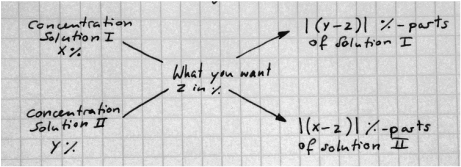
Hey there, I have had a lot of trouble with this one - probably also because I didn't practice so much... Making solutions and solvents of solutions is difficult, to me. So today we are gonna fix that ._. To calculate solutions with a concentration, there is a very simple formula the so called Andreas-Cross , this is what it looks like: We have two overlapping arrows with the target solution (Sol Z) and it's concentration we want to produce in the middle. The left side shows our base material (Solution I (Sol X), Solution II (Sol Y) and their respective concentrations) and on the right we will get how many parts of each solution we need to create Sol Z , by subtracting the percentage from Sol Z from Sol X / Sol Y and taking the modulus from that. *BUTT* Take a good look at the picture - Sol Y tells you how many parts of Sol X you need and the other way too!! 1. Example Sol X = 35% Acid; Sol Y = 15% Acid We want a 22% Solution mixed from Sol X and Sol Y Ta...